
June 18, 2026
Choosing a home in Pacific Palisades often comes down to one hard question: do you want views, privacy, or walkability most? You can absolutely find more than one of these features in the same property, but this is not a flat, uniform market where every block offers the same lifestyle. If you are trying to narrow your search, understanding how the Palisades is physically laid out can save you time, sharpen your priorities, and help you tour with more confidence. Let’s dive in.
Pacific Palisades is shaped by mesas, canyons, and rising hillside streets. According to Los Angeles City Planning, the street pattern becomes more meandering as the topography rises from the beach into the hills, while historic commercial development is concentrated in a few small areas near West Channel Road and Pacific Coast Highway, and around Sunset Boulevard and Via de la Paz.
That matters because daily convenience is not spread evenly across the neighborhood. Instead, it tends to cluster in compact commercial nodes, while many residential streets remain lower-density and more car-oriented. In practical terms, the exact block often matters more than the neighborhood name.
Pacific Palisades has an overall Walk Score of 36, which falls in the Car-Dependent range on Walk Score’s scale. But that headline number only tells part of the story. Within the Palisades, some addresses near the village score in the high 50s or low 60s, while farther-out hillside streets can drop to 12 or even 5.
The city’s Pacific Palisades Commercial Village and Neighborhoods Specific Plan also makes the local pattern clear. It is designed to enhance the pedestrian orientation of the business centers and preserve low-intensity, community-oriented uses. HistoricPlacesLA identifies Swarthmore Avenue as a 1950s neighborhood commercial center on a single block between Sunset Boulevard and Monument Street.
If walkability matters to you, that means you should focus less on broad labels and more on address-level reality. Two homes in Pacific Palisades can offer very different day-to-day routines depending on how close they are to those walkable pockets.
Blocks near Via de la Paz, Swarthmore, and the nearby Sunset corridor are some of the strongest walkability pockets in Pacific Palisades. Representative examples in this core area score 59 and 62 on Walk Score, which fall into the Somewhat Walkable range.
If you like the idea of walking out for coffee, short errands, or casual daily trips, this is usually the first area to study. The tradeoff is that these blocks are generally closer to neighborhood activity and compact commercial areas, so they may feel less secluded than larger-lot hillside enclaves.
The Riviera stands out as one of the clearest estate-style options in the Palisades area. Los Angeles City Planning describes it as an early 20th-century subdivision with about 125 parcels, generously sized lots, some exceeding an acre, curvilinear streets, no sidewalks, and stone-and-granite street details.
That planning history helps explain why the Riviera appeals to buyers who value space, separation, and a classic estate feel. D’Este Drive was designed to accommodate pedestrians and equestrians, and the tract was planned as a suburb of home estates with a distinct sense of place.
Huntington Palisades offers a similar pull toward space and seclusion. City Planning describes it as a 226-acre mesa overlooking the ocean with broad meandering streets, large one- and two-story homes, landscaped medians and traffic islands, and lots planned to capitalize on ocean, canyon, and mountain views.
For many buyers, that combination favors privacy, lot presence, and outlooks over daily walkability. If your ideal home life centers on space and setting, this is often the type of environment that rises to the top.
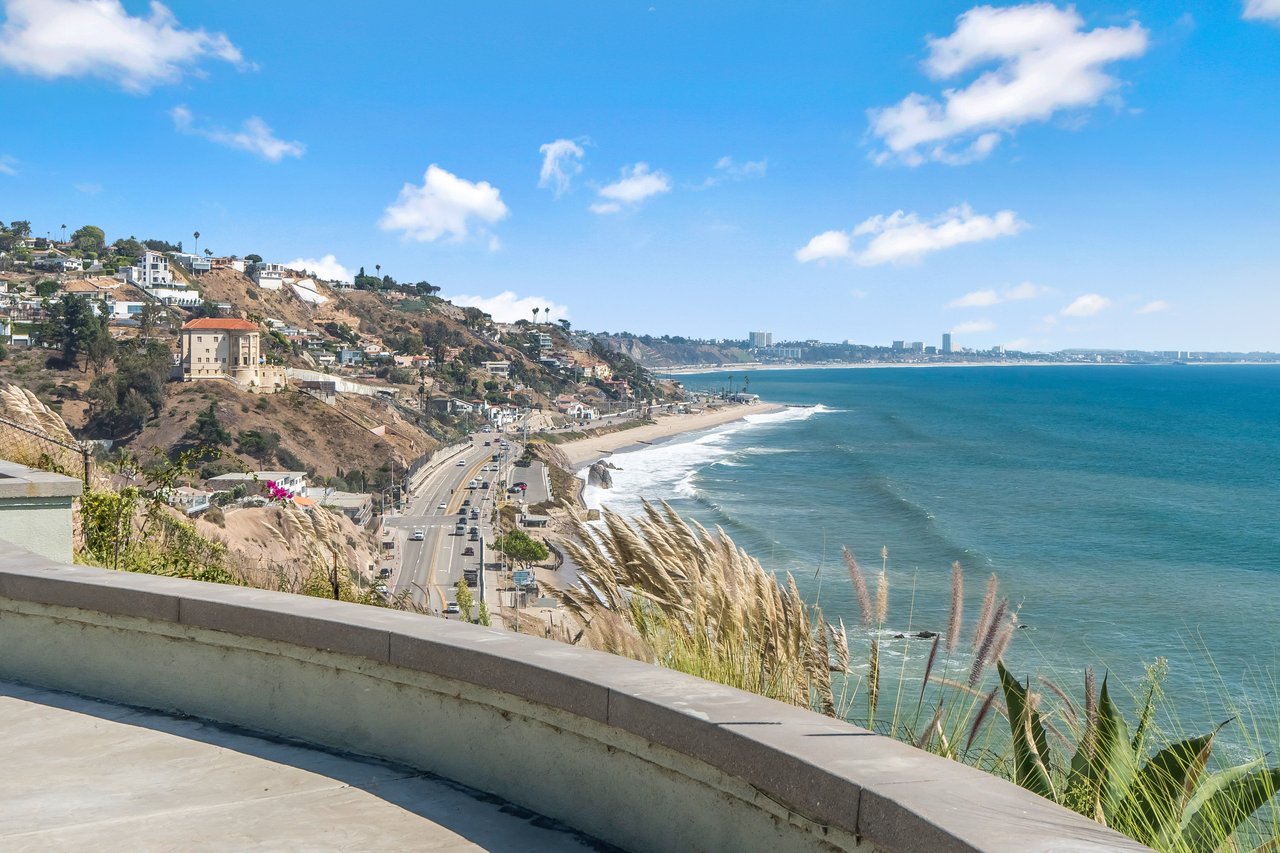
Castellammare is one of the most distinctive parts of Pacific Palisades. City Planning says it was designed to resemble the Amalfi Coast, with serpentine roadways, steep concrete hillside stairways, a pedestrian highway overpass to a private beach, and a commercial building near the overpass.
That gives the area strong coastal character and dramatic topography. It can be especially appealing if you are drawn to hillside geometry, ocean adjacency, and a more unusual physical setting. At the same time, steeper circulation can mean less everyday convenience compared with the village core.
Not every buyer wants the busiest pocket or the most secluded hillside street. Marquez Knolls can represent a practical middle ground for people who want more house and yard than the village core typically offers, but do not want the most remote canyon setting.
City Planning describes Marquez Knolls as a 118-acre residential development. The same survey notes that postwar zoning changes expanded the business district along Via de la Paz, Swarthmore, and Sunset, which helps explain why some transition areas can offer a more balanced mix of residential space and access.
The farther you move into canyon and hillside areas, the more likely you are to trade convenience for privacy. The survey report notes that Pacific Palisades’ canyons have meandering street patterns dictated by topography, and a farther-out address such as Via Pacifica shows how quickly walkability can fall, with a Walk Score of 5.
This does not mean these areas are less desirable. It simply means the lifestyle is different. If elevation, separation, and quiet are your top priorities, you should be prepared for a more drive-oriented routine.
One of the simplest ways to make a smart decision in Pacific Palisades is to force a ranking between your first and second priorities. In this market, view-plus-privacy often lives on different blocks than walkability-plus-convenience because services are concentrated in a few compact nodes while much of the residential area follows lower-density patterns.
A helpful rule of thumb is to pick only two true non-negotiables. If walkability is non-negotiable, you may need to compromise on lot size, privacy, or both. If privacy and views are non-negotiable, you should expect to drive more often for errands and daily routines.
Instead of reacting only to finishes or staging, score each home on the four traits that most often shape daily life in Pacific Palisades:
Use a simple 1-to-5 scale for each. For walkability, compare the exact address to Walk Score’s bands:
This framework helps you compare homes more clearly, especially when two properties look equally appealing online but offer very different real-world lifestyles.
Current conditions matter more than ever when touring Pacific Palisades. The January 2025 Palisades Fire caused major disruption and damage in the area, including severe losses in some neighborhoods, so current block-by-block conditions, access patterns, and rebuild activity should be verified before you draw conclusions about a street or tract.
That is especially important in a market where privacy lines, view corridors, and everyday convenience can change noticeably from one block to the next. A home search here benefits from current local knowledge, not just map browsing.
When you are weighing view, privacy, and walkability in Pacific Palisades, the right answer is rarely universal. It depends on how you actually want to live, what tradeoffs you are comfortable making, and which blocks best match your priorities. If you want help narrowing the search with a current, street-level perspective, The Cilic Group can help you evaluate the tradeoffs with clarity and discretion.
At The Cilic Group, we blend our love for real estate with a commitment to community. Partner with us to achieve your real estate dreams and make a lasting difference together.
15140 W Sunset Blvd Pacific Palisades CA 90272 Joe Cilic | CA DRE# 01421044