
November 19, 2026
On April 22, 2025, a company called Toba Properties LLC bought a burned 4,585-square-foot lot at 605 Erskine Drive in El Medio Bluffs for $1,615,000. That is about $352 per square foot of land. The house that had stood there was built in 1950 and had about 3,125 square feet. County-record sales data compiled by Pali Builds shows the sale.
Seventeen months later, a new five-bedroom house of about 3,097 square feet was finished on the same lot. The New York Post reported on October 2, 2026 that it was asking $4.29 million. The listing agent, Ryan Jancula, told the Post it was the first lot bought after the fire and rebuilt as a spec house. By mid-November the ask had been cut to $4.195 million.
Erskine is the first public record of a burned lot that was bought after the fire, built on and put up for sale as a finished house, with a price on each step. A finished house in the Palisades is now priced as land plus construction. For about a year the land has been the steady part, so construction cost is what will set the price of new homes over the next few years.
At the October ask, the gap between what the lot cost and what the house asked was about $2.675 million. Everything the builder spent and hopes to earn has to come out of that gap, for a house a little over 3,000 square feet built over about seventeen months. Spread across the house, it works out to roughly $864 per square foot of living space. The full ask works out to about $1,385 per square foot.
The second spec in the same group, 744 Iliff Street in the Alphabet Streets, asked $4.99 million in the Post's October 2 report. It is a five-bedroom house of about 3,667 square feet on a 5,000-square-foot lot. It went on the market September 10 at $4.995 million, and by mid-November the ask was $4.795 million.
Both are asking prices, not closed sales. Still, they are the first public price points for a house built on a lot bought after the fire, and agents are watching them for exactly that reason. "Those prices are going to be very important to watch because they'll set the benchmark for what new construction should sell for," Jacqueline Chernov of Beverly Hills Estates told The Real Deal in September.
Jancula described his pricing method to The Real Deal. He bases asking prices on the replacement cost to build, not on what the properties were worth before the fire. He said his new-construction listings are at least 10 percent below what they might have sold for before January 2025.
That changes what a buyer should hold an ask up against. Pre-fire comparables tell you what a house used to be worth. A spec house priced at replacement cost asks you to compare it with what you would spend to buy a similar lot and build the same house yourself, and how long you would wait for it.
Jancula gave The Real Deal a rough version of that comparison too. The least expensive lot in a "good area" runs about $1.5 million, and building on it costs another $3.5 million to $4 million, before counting the time it takes. That puts a do-it-yourself total at roughly $5 million to $5.5 million. Both spec asks sit below that range, and both are modest houses of under 3,700 square feet. The same report says developers have gone after Alphabet Streets lots because flat land is easy to build on, so the cost of building and the likely sale price of a finished house work out.
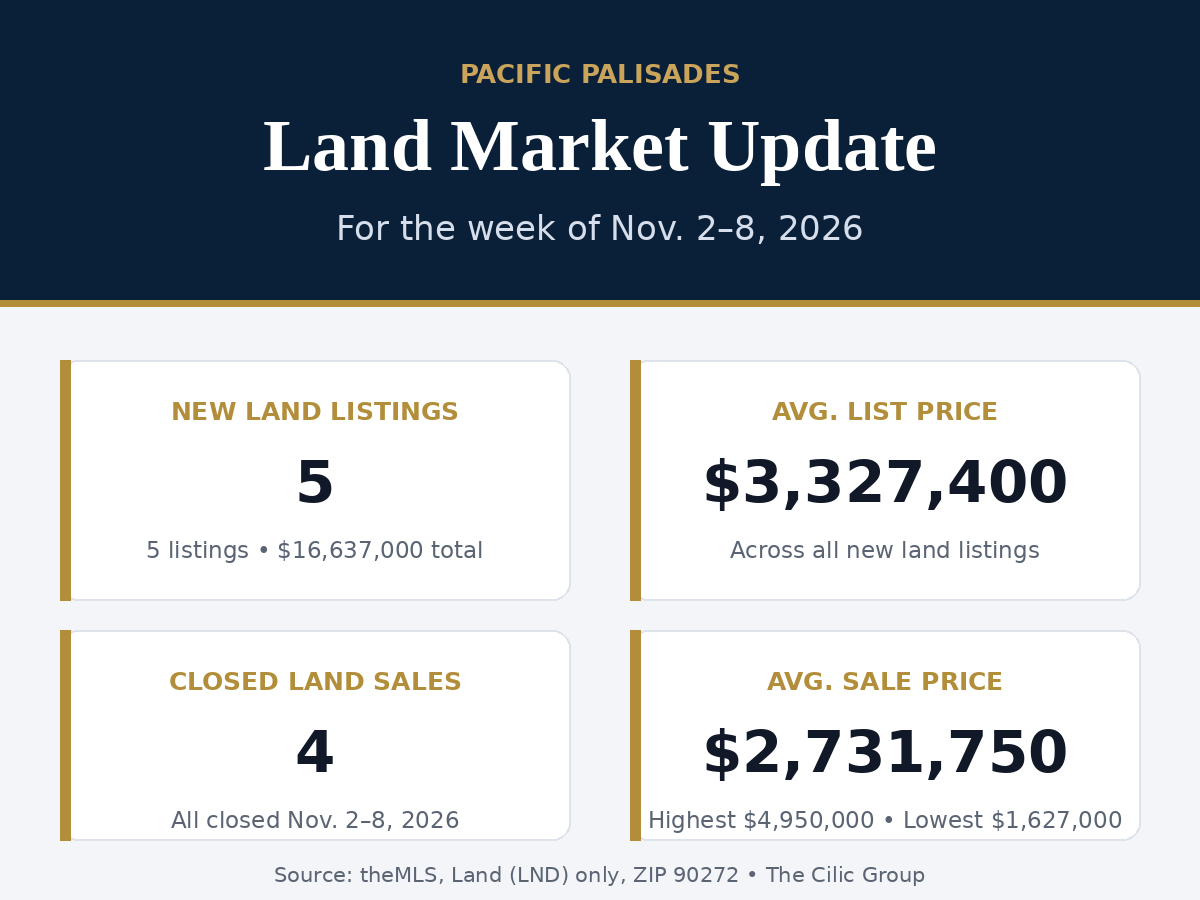
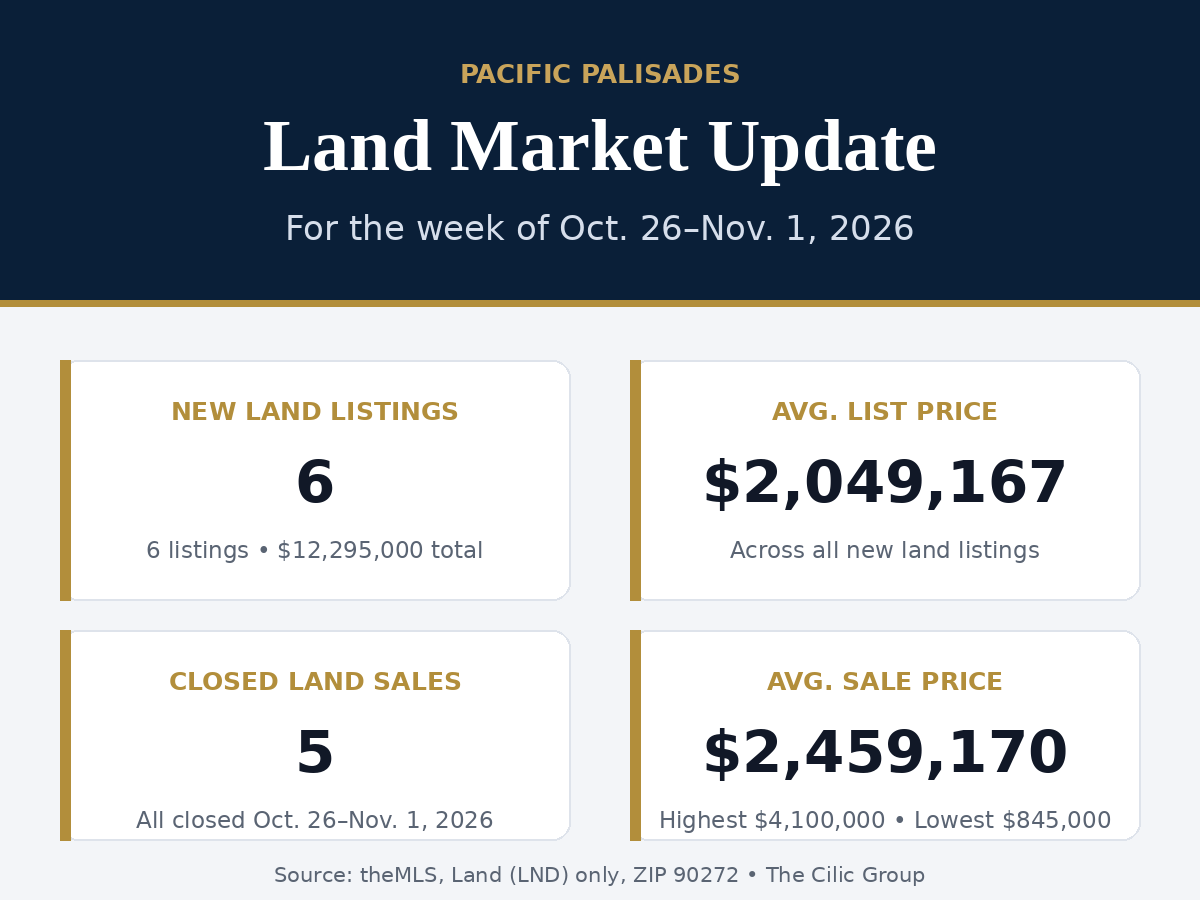
The method only works if lot prices hold still long enough to build on, and for the past year they have. In the Palisadian-Post in October, the Edlen Team reported that lot sales have recently averaged about $270 per square foot of land. That is essentially where they were in late 2025, after 147 lots sold at about $278 in the third quarter of 2025 and 131 sold at about $258 in the fourth. The same column puts the recent median lot sale near $1.8 million and estimates about 150 lots on the market as of October 2026, selling at about 32 a month. That is roughly five months of supply, close to how the whole Palisades market ran before the fire.
Against that average, Erskine's $352 per land square foot looks high. The average blends many kinds of lots, though. Individual sales have ranged from about $50 to more than $500 per square foot depending on location, views and the lot itself. Erskine sits in the upper part of that range, and it was bought in April 2025, months before lot prices settled.
Lot prices fell further than house prices will need to. The Edlen column estimates that lot values dropped 30 to 50 percent from pre-fire levels depending on location, while Jancula priced finished houses at least 10 percent below pre-fire. Because a finished house carries construction cost on top of the land, its discount from pre-fire value is smaller than the land's.
Buyers who have been watching portal medians have been looking at a distorted number. In September, The Real Deal reported that the regional MLS had logged lot sales as single-family home sales, and that those lots made up about 27 percent of reported single-family sales since the fire. Once the lots were taken out by hand, the median for single-family homes sold in the Palisades over the previous three months was $4.7 million, $1.3 million higher than the uncorrected figure.
The two spec asks bracket that corrected $4.7 million median, Erskine below it and Iliff just above. Before the correction, a $4.29 million new house would have looked expensive against a median in the low $3 millions. After it, the same house is priced a little below the typical standing home that has sold. As our earlier piece on Castellammare and Rivas Canyon argued, a median that mixes finished homes with land does not describe either one.
Land and standing homes also move at different speeds. The Palisadian-Post's August 14 market column reported 4.4 months of supply for land and 6.1 months for standing homes. About 82 percent of lot sales so far in 2026 were between $1 million and $3 million, while demand for standing homes was strongest between $2 million and $5 million. The spec houses fall right in that $2 million to $5 million band.
The spec benchmark will be tested against a fairly small number of new homes for sale. The Los Angeles Business Journal, citing the Pali Rebuild Map, reported 62 completed Palisades homes as of October. The Palisadian-Post's October 9 map update counted 1,126 primary structures under construction and 1,317 permits issued, and said about nine months after drywall is a reasonable time to finish a home.
Most of that construction is owners rebuilding to move back in. In the Post's October report, Alison White Homes had 14 Palisades houses in its pipeline, eight under construction and six in design or permitting, and only one was a spec. That one, 837 Muskingum Avenue, asked $13.99 million. Its earlier house had been demolished before the fire, so it is a different case from Erskine and does not fit the lot-to-house arithmetic above.
The Edlen column also estimates that about 700 of the roughly 4,200 properties where homes were destroyed have changed hands, and that about 2,200 original owners have neither sold nor filed to rebuild. Whatever those owners decide will shape lot supply. The specs already built show what lot plus construction comes to today.
For a buyer comparing options this winter, the specs make three paths comparable.
The builder's margin on a spec house buys time. With lot prices flat for a year, the spread between a lot sale and a finished-house ask is the clearest measure of what that time costs in a given part of the Palisades.
Has a post-fire spec rebuild in Pacific Palisades closed escrow yet? 605 Erskine Drive and 744 Iliff Street, the two spec rebuilds on lots bought after the fire, were still listed in mid-November with reduced asks. The first closed price will set the benchmark Chernov described.
Was Kagawa Street the first rebuild to come to market? The showcase home on Kagawa Street received its certificate of occupancy in November 2025, but the Los Angeles Times reported that its developer bought the property before the fire. Erskine is the first reported case of a lot bought after the fire and rebuilt for sale.
Why are Alphabet Streets lots so sought after by builders? They are flat and easy to build on, so the cost of building and the likely sale price work out, according to The Real Deal. Jancula told the outlet that buyers from outside the Palisades ask about $1 million lots there, and that none exist.
If you are deciding between a lot, a new build and a standing home, The Cilic Group can put your options through the same lot-plus-construction math with current sales on your street, and our lot and tear-down guide covers the land side. Request a confidential consultation.
At The Cilic Group, we blend our love for real estate with a commitment to community. Partner with us to achieve your real estate dreams and make a lasting difference together.
15140 W Sunset Blvd Pacific Palisades CA 90272 Joe Cilic | CA DRE# 01421044